How to Read a Ticker's Catalyst History Before You Trade the Next One
Best ever, median, hit rate, duds and frequency. Five numbers that turn a ticker's catalyst history into context in seconds, with three real examples.
One Number Can Lie to You
A breaking news catalyst hits. You open the ticker and see it once ran +488% on news.
Your pulse jumps. This one has done it before.
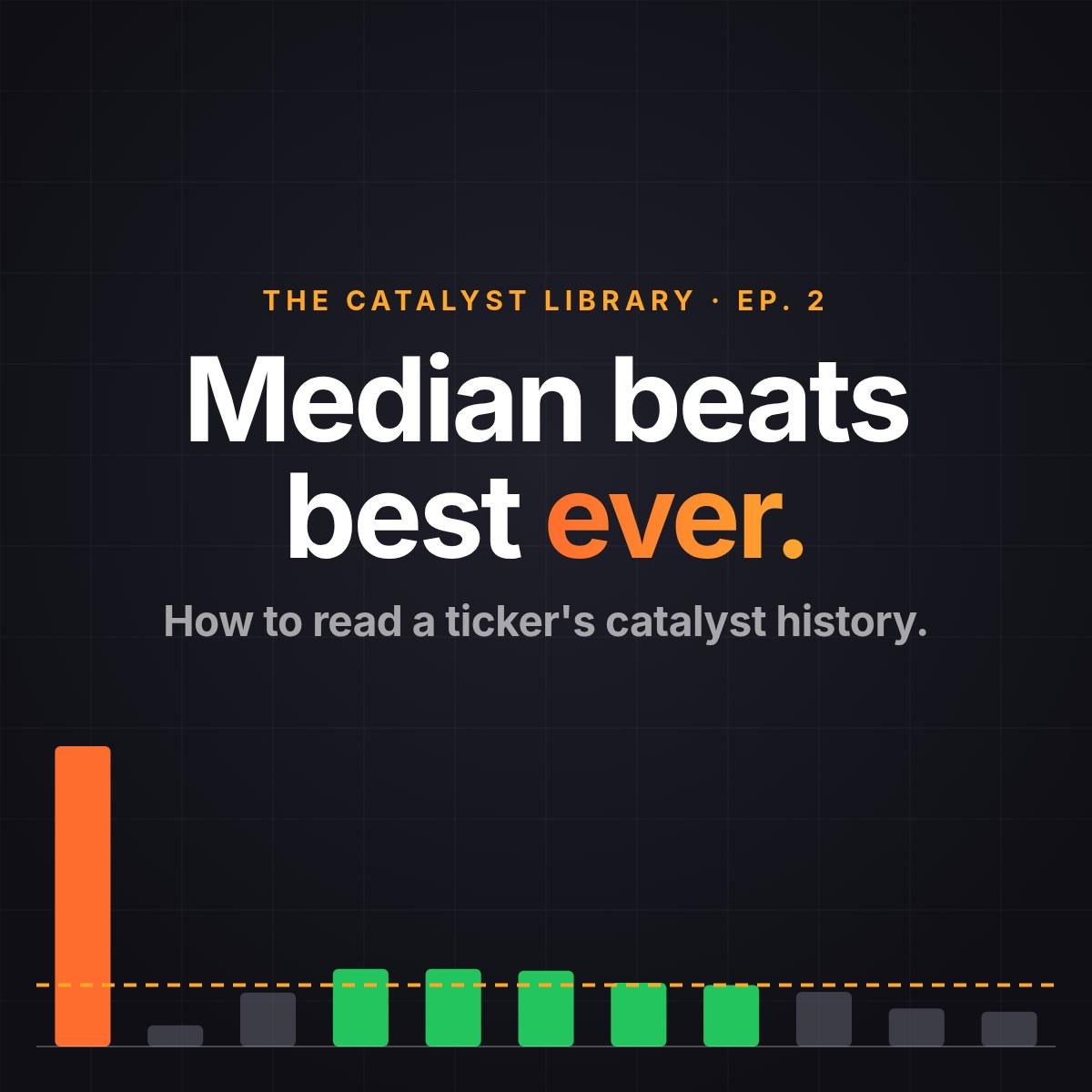
Has it, though? One big day is a story. A history is a pattern. And the two can point in opposite directions.
In episode 1 of this series, we asked the simple question: has this happened before? This time we go one level deeper. When a ticker has 10 or more past catalysts, how do you actually read them?
The Five Numbers That Matter
A ticker's catalyst history is a list of past news days and how the stock moved on each one. Every figure below is the peak move from the session open to the high on the catalyst day, as recorded in the Day Trader Sniper Catalyst Library, which holds more than 10,000 catalysts and grows every day.
Read the history in this order:
- Count and frequency: how many catalysts, and how often they come. Two in two years is a different animal from one a week
- Median peak: the middle result. Half the catalysts did better, half did worse. This is the "usual" day
- Best ever: the single biggest day. Useful, but it is the most misleading number on the screen
- Hit rate: how many catalysts reached +20% from the session open
- Duds: how many never reached +10%
Then do one more thing that no number does for you: read what the news actually was.
Profile 1: The One Big Day
Quantum Cyber ($QUCY) has 11 catalysts in the library, from May 13 to Sep 4, 2026.
| Number | $QUCY |
|---|---|
| Catalysts | 11 in under 4 months |
| Best ever | +488.4% (May 13, 2026) |
| Average peak | +61.5% |
| Median peak | +20.5% |
| Reached +20% | 6 of 11 |
| Under +10% | 3 of 11 |
Look at the gap between the average and the median. One huge day drags the average up to +61.5%. Take that single day out and the other 10 average +18.8%.
And notice when it happened. The best ever was the very first catalyst. The last four peaked at +20.5%, +16.2%, +7.8% and +6.5%.
That is the classic trap. The headline number says rocket. The history says the reactions got smaller as the news kept coming.
Profile 2: The Consistent Reactor
VCI Global ($VCIG) has 12 catalysts in the library, from Oct 13, 2025 to Oct 16, 2026.
| Number | $VCIG |
|---|---|
| Catalysts | 12 in about a year |
| Best ever | +127.6% (Oct 6, 2026) |
| Average peak | +58.4% |
| Median peak | +58.4% |
| Reached +20% | 11 of 12 |
| Under +10% | 0 of 12 |
Here the average and the median are the same. No single day is carrying the story. 11 of 12 catalysts reached +20% from the session open, and none stayed under +10%.
That does not make the next one a winner. It means that, on this ticker, the market has historically reacted to news, and reacted big. That is context, not a signal.
One more check: read the headlines. Not every item in a history is a hard catalyst. Some of $VCIG's entries are company news, and some are third-party articles about the stock. A strong history built on soft news is still worth knowing, but you want to know which kind you are looking at.
Profile 3: The Quiet Tape
AST SpaceMobile ($ASTS) has 11 catalysts in the library, all between Sep 2 and Oct 27, 2026.
| Number | $ASTS |
|---|---|
| Catalysts | 11 in 8 weeks |
| Best ever | +9.0% (Oct 27, 2026) |
| Median peak | +5.7% |
| Reached +20% | 0 of 11 |
| Under +10% | 11 of 11 |
Every single one stayed under +10%. Why? Read the news. 9 of the 11 were law-firm notices about a class action. They come often, they look like news, and the tape barely noticed them.
$ASTS is also a multi-billion-dollar company. Big names need big news to move hard, and a stream of repeated notices is not that.
This is the dud count doing its job. When a ticker's history is full of noise, a fresh headline of the same type is more of the same.
The Traps to Avoid
- Trusting the best ever: it is one day. Always check it against the median
- Trusting the average: one monster day can double it. The median is harder to fool
- Ignoring the timeline: a best ever from months ago, followed by fading reactions, tells a different story from a ticker that is heating up
- Mixing event types: a contract, an offering and a law-firm notice are not the same catalyst, even on the same stock
- Forgetting today's tape: history sets expectations. Today's volume and price action show what is actually happening now
How You See It in the App
You do not have to build these tables yourself.
When an alert fires and you open the ticker, the CATALYSTS tab has two views:
- Analytics: PEAK PRICE REACTION shows the average and median peak across the ticker's past catalysts, with chips for the total count, catalysts per year, the average gap between them and how many came this year
- History: every past catalyst as a card with its range and max high, so you can scan the timeline and read the news behind each one
Average next to median. Count next to frequency. The timeline right underneath. That is the whole read, one tap from the alert.
The Takeaway
A ticker's catalyst history is only useful if you read it honestly. Start with the median, not the best ever. Count the hits and the duds. Check how often the news comes and whether the reactions are growing or fading. Then read what the news actually was.
Three tickers, three very different stories. The numbers were there all along.
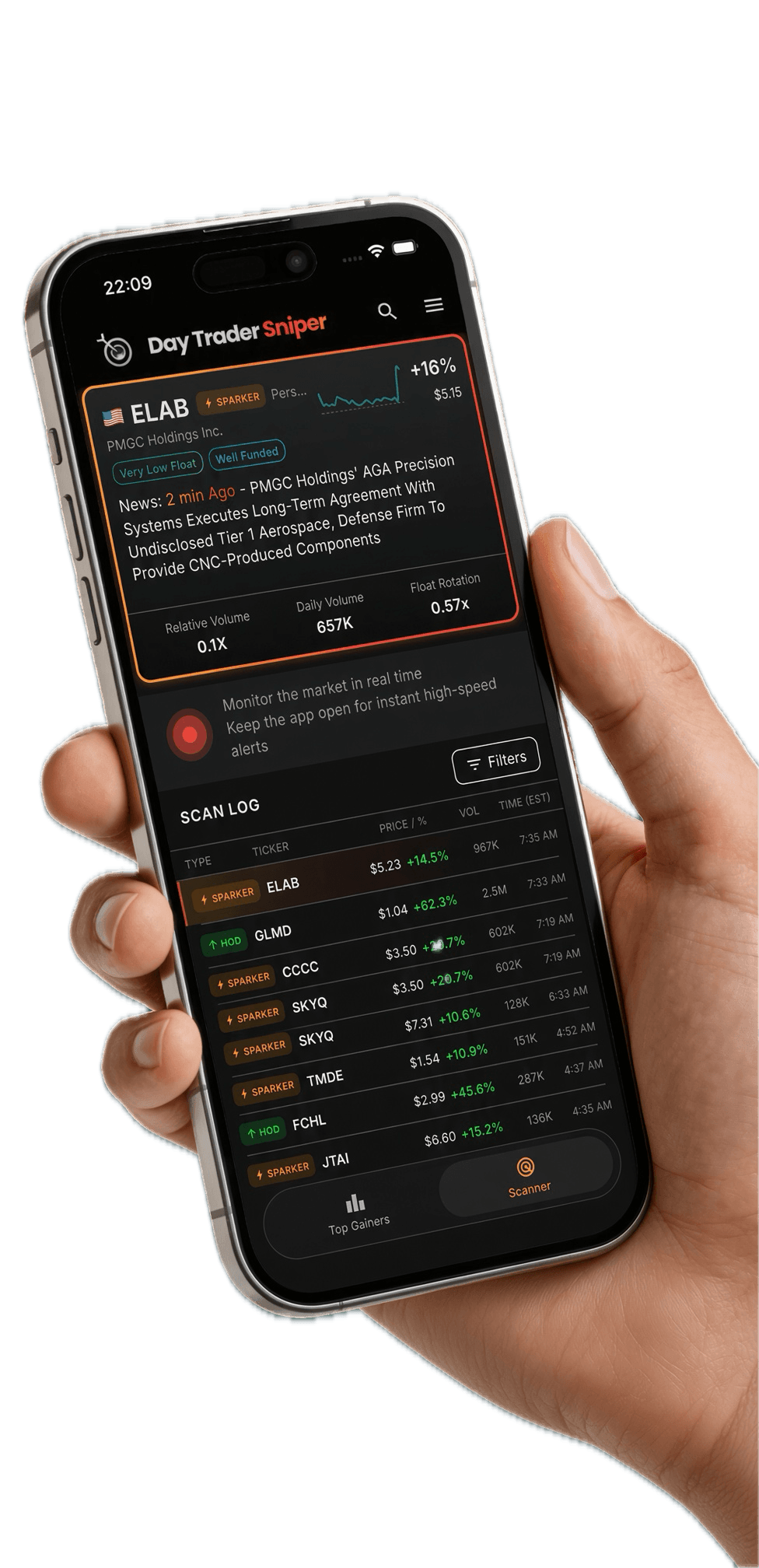
This is episode 2 of our Catalyst Library series. Episode 1 is here: https://www.daytradersniper.com/resources/has-this-happened-before-inside-the-day-trader-sniper-catalyst-library
Day Trader Sniper sends real-time catalyst and momentum alerts to your phone, with every ticker's catalyst history one tap away. Start your 7-day free trial: https://www.daytradersniper.com/?utm_source=resources&utm_medium=article&utm_campaign=how-to-read-a-tickers-catalyst-history-before-you-trade-the-next-one
Educational content only. Not financial advice. Historical figures describe past catalysts only. Past moves are no guide to future results. Trade at your own risk.