
When the News Is Older Than the Headline
A catalyst is not what the headline says. It is what the company did, and when. Four questions to ask before you trust a headline.
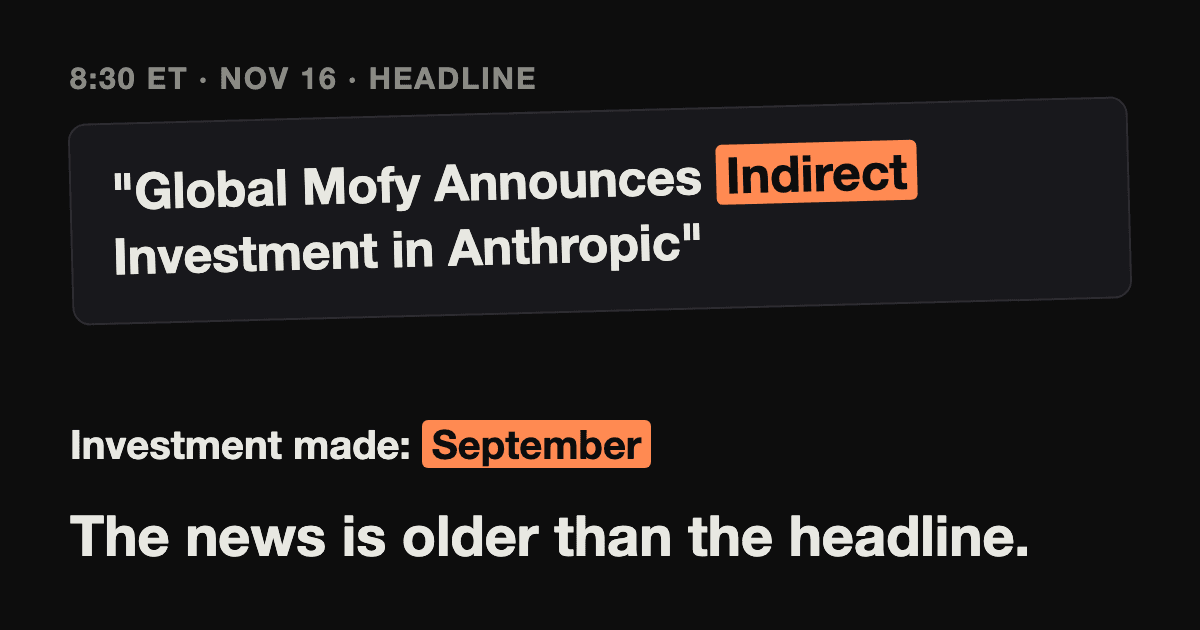
The Sniper Brief #01: GMM on November 16, part 2 of 3. 1. The story · 2. The lesson · 3. In Sniper
A headline hits at 8:30. A familiar name is in it. The stock starts to move.
The headline gets the attention. This page is about what is underneath it.
A catalyst is an event or disclosure that can lead the market to reprice a stock. Two dates matter: when the event happened, and when it was announced. They are not always the same.
Question 1: What Actually Happened?
Look for the verb. It tells you the stage of the event.
| The release says | What it means |
|---|---|
| "Completed", "closed", "received approval" | It happened. |
| "Signed", "entered into an agreement" | Signed. Check the binding terms and the closing conditions. |
| "Plans to", "intends to", "explores" | The plan or deal is not completed yet. |
| "Announces it has invested", "previously" | It happened earlier and is being disclosed now. |
Then look for the noun. "Investment" is not "partnership." "Memorandum of understanding" is not "contract." "Collaboration" is not "revenue."
Question 2: When Did It Happen?
The publication time tells you when the announcement went out. It does not tell you when the event took place.
A company can announce today something it did two months ago. That is different from a new event, and different from old news being repeated. A first-time disclosure can still be new information to the market. Ask which of the three you are reading, and why it is being announced now.
Question 3: How Much?
Deals often come with numbers: a dollar amount, a percentage, a revenue estimate, a milestone. When a release names a famous partner and leaves out every number, the missing numbers are information too.
Question 4: What Else Is in the Filings?
A headline arrives on top of a company's existing situation. Check the recent SEC filings for:
- New share offerings (424B5, or a 6-K or 8-K announcing a direct offering)
- Shelf registrations (S-3, F-3)
- Reverse splits
None of these alone tells you that shares are being sold. A shelf registration is permission to sell, not a sale. A reverse split changes the share count without adding new shares. Shares outstanding are not the same as the public float.
The same headline lands differently on a company whose share count just multiplied.
A Real Example
On November 16, Global Mofy AI (GMM) announced an "indirect investment in Anthropic."
- What happened? An investment through a fund. No partnership was announced.
- When? In September, two months earlier.
- How much? Not disclosed.
- What else? A 45 million share offering had closed ten days earlier.
The full price path and filings are in part 1, the GMM breakdown.
The Point
A large move shows how the market reacted. It does not tell you what the announcement is worth, or how long the move will last.
Next, part 3 of 3: Sparker and Fuel: Where a Move Starts and How Long It Ran. How Sniper timed the GMM move.
Day Trader Sniper provides algorithmic alerts and analysis, not trade advice. Not financial advice. Trade at your own risk.