
By the time your brain reads a catalyst, frames the context, and reaches for the buy button — the trade is over.
Institutional AI systems classify a headline and execute in under 50 milliseconds. Your minimum read-to-decision time is 2 to 5 seconds.
That is not a skill gap. That is a structural one.
And no momentum stock scanner on the market fixes it — unless it's built around that specific problem.
The Speed Gap Is Not What You Think
Most traders frame the speed problem as reaction time. If I just move faster, click faster, watch the scanner more closely — I'll catch the move.
That framing is wrong.
Price discovery on high-volume stocks completes within 300 milliseconds of a catalyst drop. The entire repricing event — the one you're trying to trade — happens before you've read the first sentence of the headline.
You are not arriving late to the trade. You are arriving to a different market entirely.
The bid you're chasing was set by algorithms that processed the filing in less time than it takes you to blink. The ask you're hitting was placed by systems that already know the float, the dilution status, and the catalyst grade — and priced that information in before your scanner even refreshed.
This is the structural reality of trading catalysts in 2025. Acknowledging it is not defeatist. It's the first step to building a framework that actually works.
Why More Data Makes It Worse
The manual workaround most traders default to — more tabs, more Discord alerts, more "breaking news" accounts — only deepens the problem.
Studies show retail traders already spend 80% of their time gathering data and just 20% analyzing it. More inputs does not fix that ratio. It buries it.
The Human-AI Loop makes it worse: find the news, copy-paste it into a consumer AI, wait for the summary, switch to the broker. That loop runs at 30 to 90 seconds. You're not just late — you're processing a market that no longer exists.
The information overload problem in day trading is not about the quality of your data sources. It's about the architecture of how data reaches your decision. More feeds, more alerts, more noise creates the illusion of edge. What it actually creates is cognitive load — the thing that makes traders hesitate, second-guess, and miss the entries they called correctly.
What a Momentum Stock Scanner Actually Needs to Do
Most scanners are built to find stocks, not to make decisions faster.
They surface tickers. They show price movement and relative volume. They give you the raw inputs and leave the aggregation to you — the slow part of the system.
That's the wrong design for catalyst-driven small-cap trading.
A momentum stock scanner that actually serves a retail trader in this environment needs to do three things the standard scanner doesn't:
1. Pre-rank the signal before it reaches you.
Not all catalyst moves are equal. A scanner that surfaces every gapper equally forces you to triage — which reintroduces the cognitive load problem. The signal needs to arrive already sorted: hard catalyst or soft, dilution risk or clean, high relative volume or noise.
2. Attach context to the alert, not just the ticker.
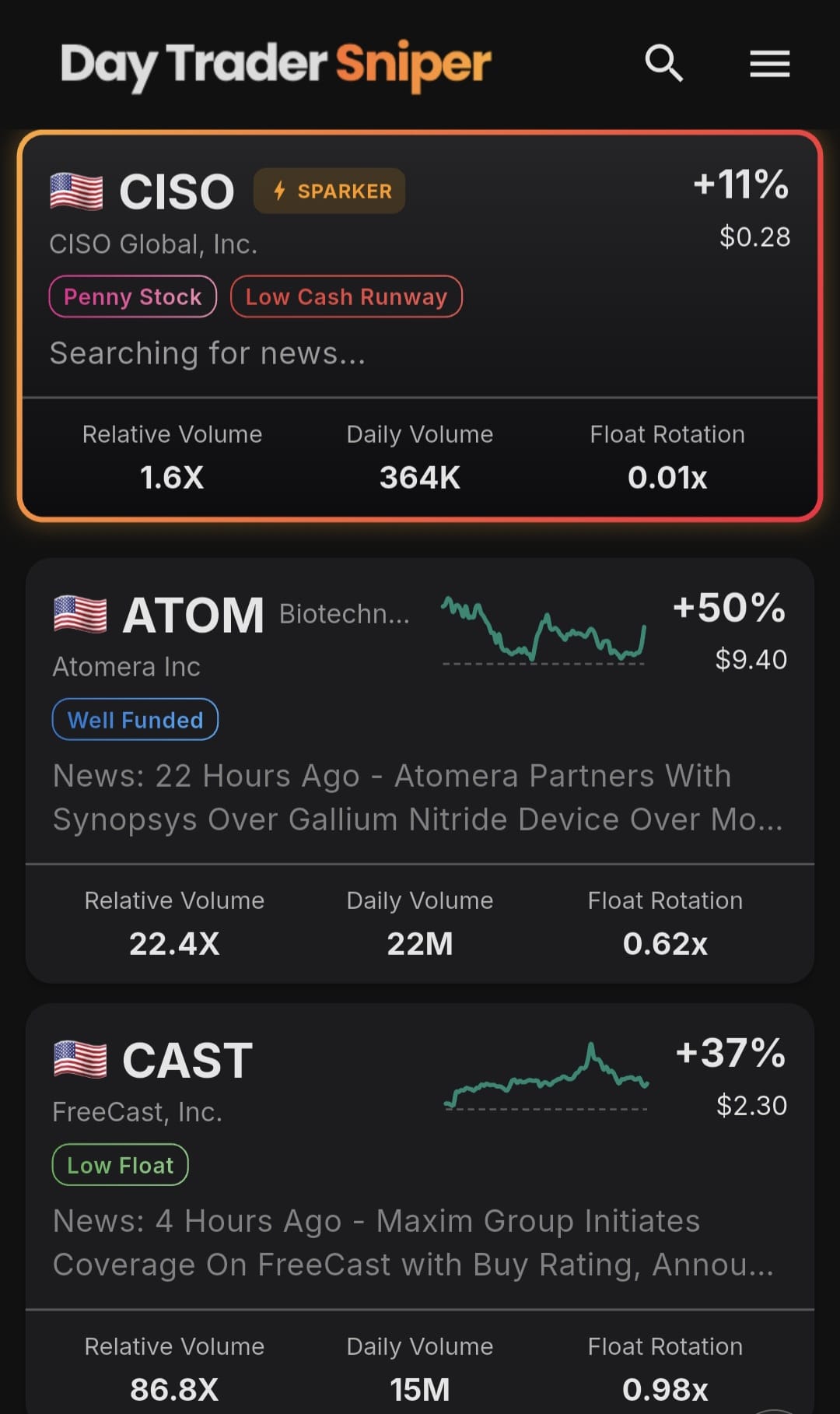
Float, cash position, catalyst grade, dilution status — these are the five data points that determine whether a move is tradeable. They should arrive with the alert, not require three additional lookups.
3. Fire before the first candle, not during it.
The entry window on a low float catalyst play is 30 to 90 seconds. An alert that fires when price is already moving is not an early alert — it's a confirmation that you missed it.
The False Solution: Chasing Speed
Traders who recognize the speed gap often try to solve it by compressing time. Faster internet. Hotkeys. Level 2 always visible. One-click order entry.
These improvements matter at the margin. They do not solve the structural problem.
Competing on the machine's terms — raw data volume, millisecond reaction — is not a race you can win with a browser window. The infrastructure gap between a retail setup and an institutional algo is measured in orders of magnitude, not seconds.
The traders who navigate catalyst moves consistently are not the fastest clickers. They're the ones who removed the data-gathering step from the decision loop entirely.
That's a different problem with a different solution.
How Scanner 360 Removes the Race
Scanner 360 was built around one premise: the aggregation should already be done by the time the alert reaches you.
Every catalyst, every alert, filtered and ranked in real time — before you've opened a second tab. You stop processing the feed. You start executing against it.
The signal is already ranked. The context is already attached. Your 2 to 5 seconds go where they've always mattered most: the decision.
Not "is this a real catalyst?" — that's answered.
Not "what's the float?" — that's in the card.
Not "is there dilution overhang?" — Dilution Guard already ran it.
The only question left is the one only a human can answer: does this setup fit my risk tolerance right now?
That's the edge. Not faster data. A shorter path from data to decision.
FAQ
What is a momentum stock scanner?
A momentum stock scanner is a tool that identifies stocks with unusual price movement and volume, typically triggered by a catalyst event. The best scanners pre-filter by catalyst quality, float, and dilution status — not just price action.
Why do retail traders miss catalyst moves even with a scanner?
Most scanners surface the ticker without the context. Traders still need to manually look up float, catalyst type, and dilution status — a process that takes 3–5 minutes while the move happens in the first 60 seconds.
Can retail traders compete with institutional algorithms on speed?
Not on raw speed. Institutional systems execute in under 50 milliseconds. The retail edge comes from removing data-gathering latency — not from trying to match machine reaction times.
What should a real-time stock catalyst alert include?
Float, catalyst grade (hard vs. soft), dilution status, relative volume, and cash position. All five determine trade viability. An alert that only gives you a ticker name forces manual lookups and reintroduces the latency problem.
How is Scanner 360 different from a standard stock scanner?
Standard scanners find stocks. Scanner 360 ranks signals and attaches pre-built context — catalyst grade, float, dilution status — before the alert reaches you. The aggregation is done. The decision path is shorter.
The Bottom Line
The speed gap between retail traders and institutional systems is structural. It cannot be closed with a faster feed or more Discord alerts.
The traders who catch catalyst moves are not faster. They're operating with less friction between the signal and the decision. That's an infrastructure advantage — and it's the one that actually compounds.
If you want every catalyst alert pre-ranked and context-loaded before the first candle forms, Day Trader Sniper fires the signal the moment it's real.
Know before you enter.
Disclaimer: Setup Score and HCS Grade are algorithmic filters, not trade advice. Dilution Guard™ status is parser-generated; always verify via the raw SEC filing. Day Trader Sniper is not a registered investment advisor. We are not responsible for execution latency or trade outcomes. Trade at your own risk.




©2026 Sniper Trading - all rights reserved