
The stock hit your scanner. Volume spiked. You did exactly what you were taught - validate. You switched tabs, confirmed the news, pulled up the chart, looked for the liquidation zone.
By the time you clicked "Buy," it had already ripped 25%.
You weren't wrong. You were just 4 minutes too late.
The 60-Second Window Most Traders Never See
82% of small-cap stocks lose their primary directional momentum within the first 5 minutes of a headline hitting the tape.
The initial price spike - that first 15% move - executes in the first 48 seconds.
Your manual validation loop takes over 4 minutes: a minute switching to a news platform, another 2 if you used AI chat to confirm the catalyst, and 1 minute 18 seconds to run the scan-to-validate.
The "easy money" window closes in 60 seconds. You're entering just as the smart money starts looking for the exit.
This is not a skill problem. It's an infrastructure problem.
Why Moving Faster Doesn't Fix It
Traders try to fix this by moving faster. Clicking faster. Tabbing faster.
It doesn't work.
You can't out-click a fragmented system. When you manually process five data points under a ticking clock, you hit a cognitive bottleneck - you hesitate, double-check, and miss the entry you already called correctly.
Speed without infrastructure is panic.
The market doesn't reward the quality of your research. It rewards the speed of execution on good enough information.
What Day Trading Catalysts Actually Require
Most traders treat a catalyst as a news event to be confirmed. That's the wrong frame.
A catalyst is a race condition. The moment a filing hits EDGAR or a headline crosses the wire, the clock starts. Every second you spend switching tabs is a second someone else is using to size in at the right price.
What you need at the moment a catalyst hits:
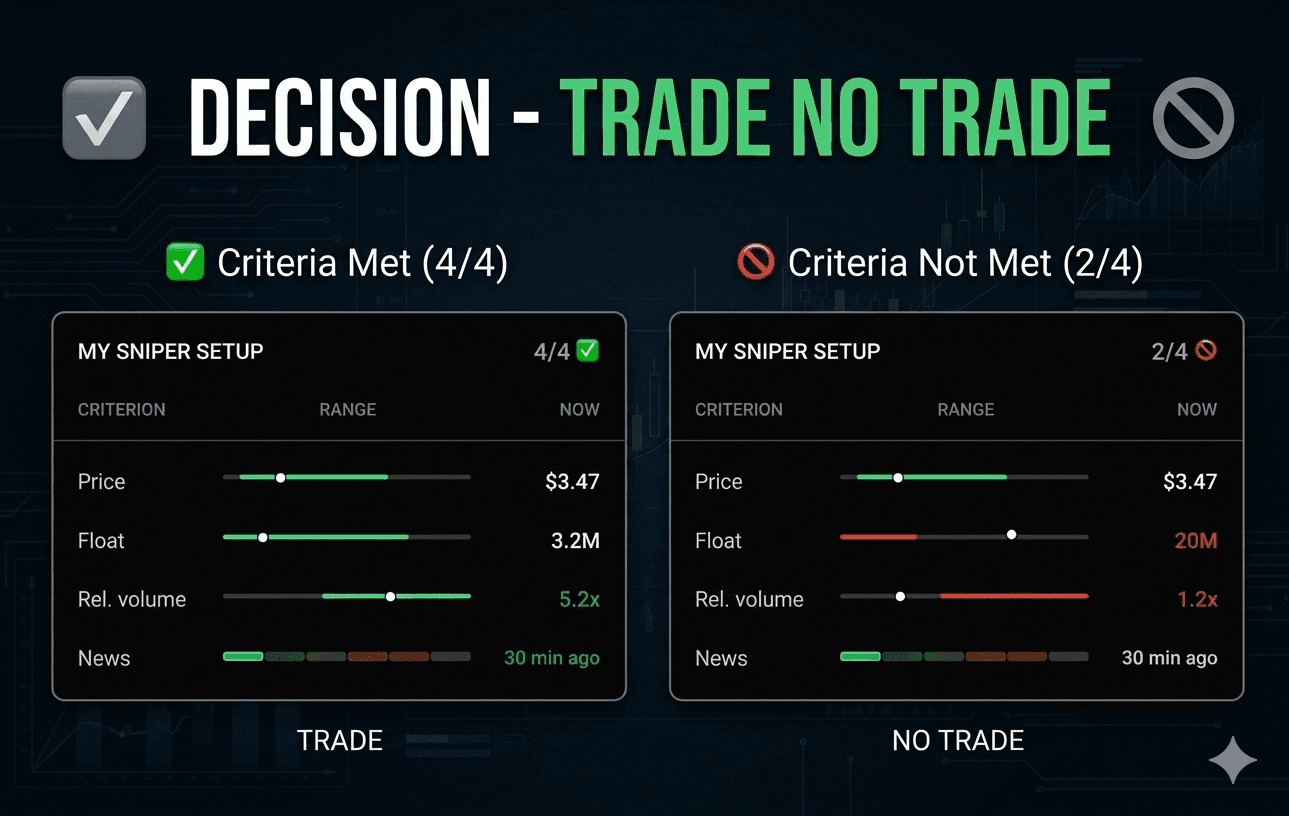
Float - Is this a 2M share float or a 20M share float? That determines velocity.
Cash runway - Is the company funded enough to matter, or is this an ATM distribution event?
Catalyst grade - Hard or soft? Binary or speculative? This is the single most important filter.
Dilution status - Is there an active shelf offering that turns this catalyst into an exit ramp?
Relative volume - Is the move being confirmed by real buyers, or is it thin air?
These five data points determine the trade. Gathering them manually across five different tabs while a low float stock is moving 40% is not a process - it's a lottery.
The Pre-Market Advantage
The traders who consistently catch catalyst moves early are not faster at clicking. They're positioned before the open.
Pre-market preparation collapses the in-session decision time. If you already know the float, the dilution status, and the catalyst type before 9:30, your in-session decision is binary: does the open confirm the setup or not?
That's a 10-second decision, not a 4-minute validation loop.
The challenge: most meaningful catalysts - SEC filings, FDA decisions, reverse merger completions - drop outside market hours. You won't catch them by watching your scanner during the session. You need an alert that fires the moment a filing hits, with the context already attached.
How Day Trader Sniper Collapses the Loop
Day Trader Sniper was built to eliminate the tab-switching problem.
The Catalyst Card delivers float, cash runway, Headline grade, and every kill stat that matters - in one place, before the rest of the market finishes reading the headline. No tab switching. No manual lookup. A Trade/No-Trade decision in under 30 seconds.
The alert fires before the first candle forms.
That's the infrastructure edge. Not a better scanner. Not a faster internet connection. A pre-built decision framework that fires the moment the catalyst is real.
FAQ
What is a day trading catalyst?
A day trading catalyst is a verifiable event - FDA approval, earnings beat, reverse merger, SEC filing - that forces an immediate repricing of a stock. Hard catalysts produce tradeable moves; soft catalysts often reverse quickly.
How fast do stocks move on a catalyst?
On low float stocks, the initial directional move executes within the first 48 seconds of a headline hitting. Most of the day's range is established in the first 5 minutes.
Why do I always miss the first move on catalyst stocks?
Manual validation - switching tabs, confirming news, looking up float and dilution - takes 3–5 minutes on average. The primary momentum window closes in under 60 seconds.
What information do I need before trading a catalyst?
Float, dilution status (active ATM or shelf offering), catalyst type (hard vs. soft), relative volume, and cash position. All five determine whether the move is tradeable or a distribution event.
What is a real-time stock catalyst alert?
A real-time stock catalyst alert fires the moment an SEC filing or news event hits, with pre-built context (float, catalyst grade, dilution status) already attached - so the trader can make a decision without manual validation.
The Bottom Line
Day trading catalysts is not about being smarter than the market. It's about having the right information at the right moment - before the first candle forms, not after the move is already up 25%.
The traders who catch catalyst moves consistently didn't build a better validation checklist. They eliminated the manual validation loop entirely.
If you want real-time catalyst alerts with float, dilution status, and catalyst grade already attached - before the first candle prints - Day Trader Sniper fires the alert the moment it hits.




©2026 Day Trader Sniper - all rights reserved