
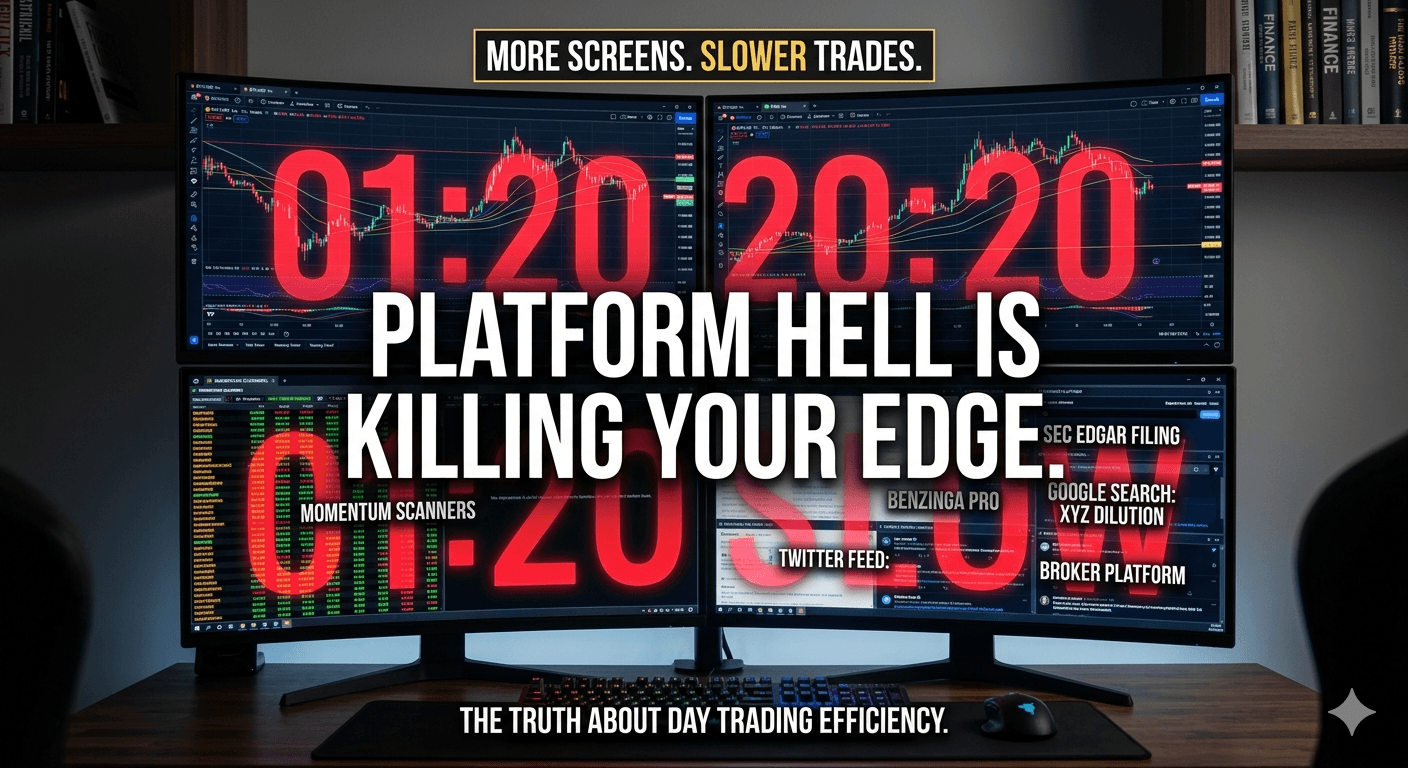
You got rugged. Or you missed a move. So you added another tool.
That's the pattern. Another scanner, another news feed, another monitor. The logic feels right - more data, better decisions. Traders do this constantly. And it's one of the most expensive mistakes in the game.
More screens don't make you faster. They make you slower. Here's why.
The Setup Most Traders Are Running
Walk into any serious retail trader's home office and you'll find the same setup: three monitors minimum, a broker platform, a momentum stock scanner, a news feed, a SEC filing tab, and Google on standby for whatever the other four didn't catch.
Each tool gets opened for a reason. The scanner fires. The news feed confirms the catalyst. Google explains the filing. The broker executes. Rational, right?
The problem is the time between each step. In small-cap momentum trading, 60 seconds is an eternity. The move from the scanner trigger to the Google search to the entry decision often runs 90 to 120 seconds. By that point, the float has rotated, the spread has widened, and the traders who moved in the first 30 seconds are already up. You're buying their exit.
What a Momentum Stock Scanner Actually Does
A scanner identifies stocks meeting specific criteria - volume spike, price breakout, relative volume above a threshold. It tells you what is moving.
It does not tell you why. It does not tell you if the catalyst is real or noise. It does not tell you if the company has an active shelf registration ready to dump 20 million shares into your buy order. It does not tell you if the headline is a Tier 1 catalyst or a routine board change dressed up as news.
That gap - between what is moving and why it's moving - is where most traders lose money. They fill that gap by opening more tabs. Benzinga for the headline. SEC Edgar for the filing. Another window for the float data. Each tab adds latency. Each latency adds risk.
The scanner gave you the signal. The five apps you opened trying to verify it cost you the trade.
The Real Cost of Platform Hell
Call it what it is: Platform Hell. Trading app, news site, scanner, fundamentals screen, Google - five platforms, one trade decision, a 90-second lag that turns a clean entry into a chasing position.
The cost is not the missed trade alone. The cost is mental energy. Every context switch resets your brain. You're not losing time - you're losing decision quality. By the time you've confirmed the catalyst across three sources, you're trading on fumes. The next setup, you hesitate. The hesitation costs you more than the research did.
What Fewer, Faster Inputs Actually Look Like
The traders who move in the first 30 seconds of a catalyst are not smarter. They have fewer decisions to make at the moment of execution.
They know the float before the alert fires. They know whether dilution is a risk before the stock moves. They know whether the headline is a hard catalyst or noise before they size the position. All of that context is pre-loaded. The alert is the trigger, not the start of the research process.
When the alert fires and you already have catalyst classification, dilution status, float, and relative volume in front of you - the decision takes seconds. Not because you're faster. Because the tool already did the filtering.
Common Mistakes to Avoid
Adding tools without removing tools. Every new subscription that doesn't replace something existing adds net complexity. If you're at five platforms and you add a sixth, cut one or the new one makes things worse.
Confusing data volume with data quality. Five news feeds don't give you five times the edge. They give you five times the noise. Gold signals are rare - two or three per day in a busy market. A scanner that surfaces those without the other 497 is worth more than a feed that shows all 500.
Starting research after the alert fires. If you're opening SEC Edgar after the scanner triggers, you're already behind. Dilution risk, cash runway, and float data need to be available at the moment of the alert.
FAQ
Does using more scanners improve your win rate?
No. Adding scanners increases noise and decision lag. A single, well-configured scanner with integrated catalyst and dilution data outperforms multiple independent tools every time.
What should a momentum stock scanner include beyond price and volume?
Float, relative volume, catalyst type, and dilution status. Any scanner missing the last two is giving you half the picture.
How many platforms should a day trader run simultaneously?
One integrated platform is the target. If you're running more than two, you're creating latency the market will charge you for.
The edge in small-cap trading is not more data. It is faster, cleaner data - delivered at the moment of decision, not after a five-tab research loop.
If you want your momentum stock scanner to fire with catalyst classification, dilution status, and float data already attached, Day Trader Sniper does exactly that. One platform. Real-time alerts. No research loop required.




©2026 Day Trader Sniper - all rights reserved