
Most traders lose the trade before they enter it.
Not because their technical setup was wrong. Not because they missed the chart pattern. Because they didn't know what was actually moving the stock — or whether it was worth moving at all.
That's the catalyst problem. And if you're trading small-cap momentum stocks without understanding it, you're not trading. You're guessing.
A stock catalyst is any event that directly causes a sudden, significant change in a stock's price and volume.
Not speculation. Not a rumor. An event — something that happened, got filed, or got announced — that forces the market to reprice the stock immediately.
For day traders, catalysts are the game. Without a catalyst, there's no momentum. Without momentum, there's no trade.
Common stock catalysts include: FDA approval or clinical trial results (BioPharma stocks can move 50–200% on a single readout), SEC filings (S-1s, S-3s, 8-Ks — these move stocks, some up, some kill them), earnings beats or misses (especially on small-caps where analyst coverage is thin), reverse mergers and ticker changes (new shell, new float, new momentum setup), partnership or licensing announcements (legitimate ones move, most don't), and dilution events (ATM offerings, shelf registrations, PIPE deals — the kind that end trades).
This distinction is what separates informed traders from exit liquidity.
A hard catalyst is verifiable, binary, and priced immediately. FDA approval. Earnings report. Signed contract filing. The event either happened or it didn't. The market reprices fast and aggressively.
A soft catalyst is vague, speculative, and often manipulated. "Company enters into preliminary discussions." "Strategic partnership announced." "Management believes near-term milestones will be achieved."
Soft catalysts move stocks too — because retail traders can't tell the difference fast enough. By the time the market figures out the headline was noise, institutions have already exited and the chart is rolling over.
The hard/soft distinction is the first filter a momentum trader runs. If you can't verify it in a filing, it's soft until proven otherwise.
Momentum trading runs on one fuel source: real volume driven by real news.
Without a catalyst, volume spikes are random. With a catalyst, they're directional — at least for a window.
Here's what a well-timed catalyst trade looks like: Hard catalyst hits (FDA approval, earnings beat, 8-K filing). Float is low (under 10M shares ideal). Relative volume spikes (5x, 10x, 20x average). Price gaps up pre-market or opens with momentum. First candle confirms direction. Trader is already positioned or entering on the first pull.
That sequence happens in minutes. Often in seconds. The window is narrow — most small-cap momentum plays peak within the first 5 to 15 minutes of the move.
Miss the catalyst identification and you're chasing. Chasing means you're buying from the traders who were ready.
Not every catalyst is a setup. Some are exits disguised as entries.
The most dangerous catalyst trap in small-cap trading is the dilution catalyst. The headline reads positive — new funding, strategic partnership, expanded facility. The stock pops pre-market. Traders pile in.
What the headline didn't say: the company filed an S-3 shelf offering two weeks ago. They have $400K in cash and a going concern notice. The "funding" is a PIPE deal that just unlocked 20 million new shares into a 5-million-share float.
The move up was the distribution. You were the exit.
This isn't rare. It's the playbook for dozens of small-cap promotions every quarter. The only way to avoid it is to cross-reference the catalyst against the SEC filing data — cash position, shelf registration status, ATM activity — before you enter.
When a catalyst hits, run this filter before touching the stock:
Is it hard or soft? Can you verify it in an SEC filing or a verifiable press release? If the source is unnamed or the language is vague, it's soft. Trade accordingly or don't trade.
What's the float? Low float (under 10M shares) amplifies catalyst moves. High float (50M+) dilutes them. Same catalyst, different float — completely different trade.
Is there a dilution overhang? Check the most recent S-3, S-1, or 8-K. Is there an ATM agreement? A PIPE deal? A shelf offering? If yes, the catalyst may be a managed exit, not a genuine breakout.
Where is the relative volume? Catalyst without volume confirmation is noise. You want to see 5x relative volume minimum before treating a catalyst as real.
What's the pre-market behavior? Is the stock gapping up cleanly? Or is it halting, fading, and reversing before the open? Pre-market price action tells you how institutional desks are treating the catalyst.
Run this filter in under 60 seconds, and you've already eliminated most bad trades before you make them.
A stock catalyst is the starting point of every momentum trade worth taking. But the catalyst alone isn't the edge.
The edge is knowing — before you enter — whether the catalyst is real, whether the float can move, and whether the filing history is clean or dirty.
Most traders only see the headline. The traders who win consistently see everything behind it.
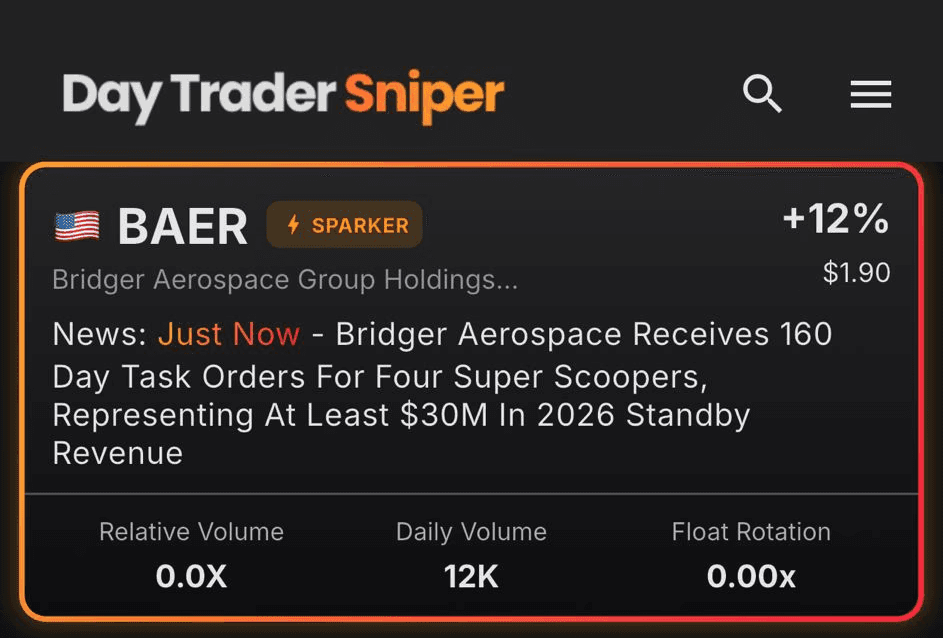
If you want to know what's actually driving a stock before the first candle prints, Day Trader Sniper fires real-time catalyst alerts the moment an SEC filing or news event hits — with Dilution Guard status already attached.
Know before you enter.
Disclaimer: This article is for educational purposes only and does not constitute financial or investment advice. Trade at your own risk.




©2026 Sniper Trading - all rights reserved