
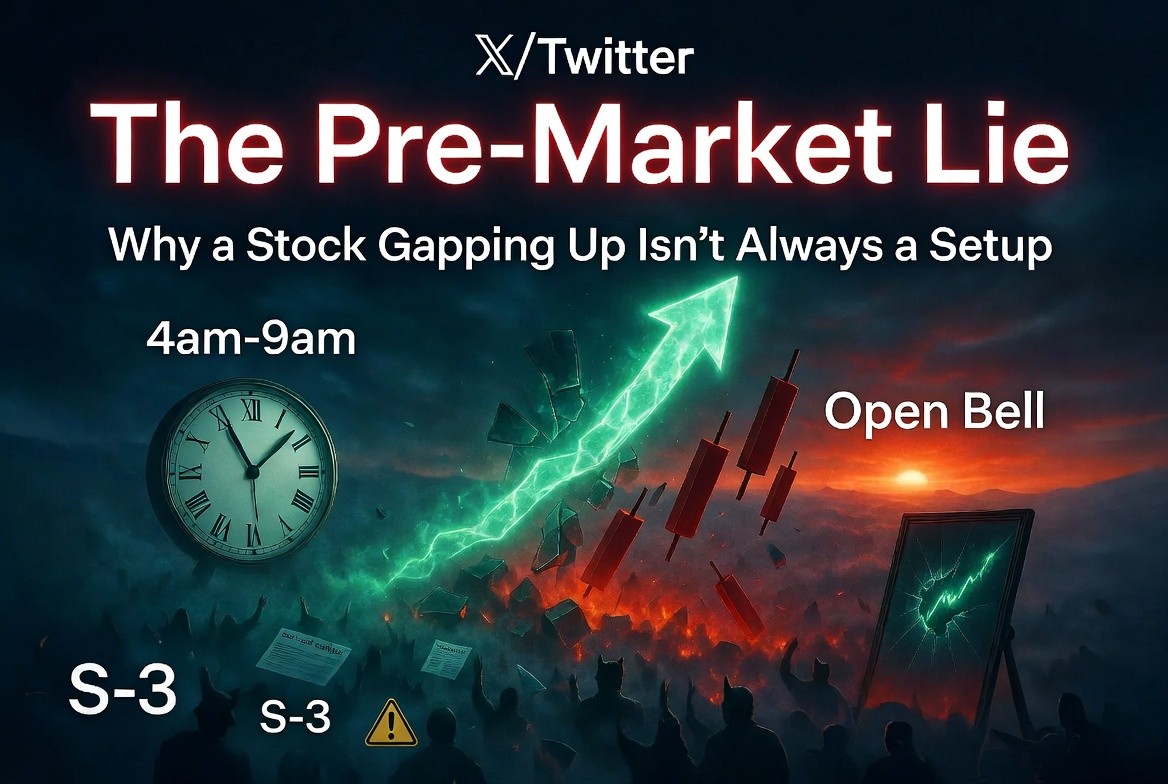
The stock is up 35% pre-market. Volume is building. The headline crossed an hour ago. By the open bell it looks like the move of the day.
Then it opens. Dumps 25% in the first three minutes. Halts. Reopens lower. Everyone who bought the gap is holding a loss.
This plays out every week. Traders read the gap as demand and get caught. The thin conditions that create the gap are the same ones that hide what it actually is.
What a Pre-Market Gap-Up Actually Is
Pre-market trading runs from 4am to 9:30am EST. Volume is a fraction of the regular session. Spreads are wider. The participants differ - fewer retail traders, more institutional and algorithmic positioning.
A stock gapping up pre-market moves in a low-liquidity environment, and that changes what the price means. In thin markets, small orders create large price swings. A stock can gap 40% on pre-market volume that would move it 5% during regular hours. The price reflects order imbalance in a near-empty market, not genuine demand. Read it that way and you avoid most pre-market traps.
The Three Types of Pre-Market Gap-Ups
The type of gap determines whether it's a setup or a distribution event.
Type 1: Hard Catalyst Gap. The stock is gapping on a verifiable, material event - FDA approval, an earnings beat with raised guidance, a signed contract with a named counterparty. The hard catalyst is real, fundamentals support the move, and the dilution picture is clean. This gap has follow-through potential. Institutional buyers positioned pre-market, retail momentum adds to the move, and the gap holds or extends.
Type 2: Soft Catalyst Gap. The stock is gapping on noise - a vague "strategic review," a letter of intent with unnamed parties, a release built on "potential" and "expected." Financials are weak, cash runway is short, and an S-3 shelf registration or active ATM sits on file. This gap is a managed distribution event. Connected parties use the pre-market spike to sell shares into retail buying, and it fades at the open.
Type 3: Sympathy Gap. The stock is gapping because a sector peer reported strong results. No direct news on this ticker. A low float makes the sympathy momentum real, but the setup lacks a fundamental catalyst, so reversal risk runs higher than a Type 1 gap. Size accordingly.
How to Classify a Gap Before the Open
Before the bell, run four checks on any stock gapping up.
1. Is the headline hard or soft? Find the actual SEC filing or press release, not the headline. Hard catalysts carry specifics: dollar amounts, named partners, approval letters, results data. If you can't find the specifics in 30 seconds, the catalyst is probably soft.
2. What is the dilution status? Check the S-3 shelf and ATM activity. A company with an active ATM is structurally positioned to sell shares into any spike. The pre-market gap is an opportunity for them, not for you.
3. What is pre-market volume relative to float? A 2-million-share float that has traded 500,000 shares pre-market has already turned 25% of its float - real activity. A 20-million-share float that has traded 50,000 shares has given you almost no volume confirmation.
4. What happened to this company's last three gaps? If it has gapped three times in six months and dumped each open, the fourth gap is a playbook, not a setup.
What the Open Bell Reveals
The first five minutes of the regular session are the most informative minutes of the day on a gapper.
Holding the gap: bid support near the pre-market close, buyers stepping in on dips, volume confirming. A Type 1 gap behaving correctly.
Immediate rejection: opening print near the pre-market high, then a flush below the prior close. That's distribution - the gap was engineered to sell into open buying.
Low-volume grind: the stock opens near the gap and drifts sideways on thin volume. The pre-market move was positional, not demand. Watch for the breakdown.
Common Mistakes to Avoid
Buying the gap pre-market. Unless your risk management is built for pre-market spreads, the regular-session open gives you better information at better prices.
Treating every gap-up as confirmation. The gap is a question. The open answers it.
Ignoring a company's gap-and-dump history. Some companies gap on catalysts that never follow through because the market keeps buying their headline. Knowing that history before the open is actionable.
FAQ
Should I always wait for the open before trading a stock gapping up? For most retail traders, yes. The information available at 9:35am beats what you have at 8am, without the pre-market spread and liquidity risk.
How do I tell if a gap will hold or fade at the open? Watch bid depth on the Level 2 at 9:28–9:30. Real institutional interest shows visible buy-side depth near the pre-market close. Thin bids suggest positioning, not demand.
What is the most common reason gap-ups fail? Dilution. Companies with active shelf registrations gap on soft catalysts because the spike is an exit. Retail buying at the peak is what makes that exit possible.
A stock gapping up is a question. The answer comes from the catalyst type, the dilution picture, and the first five minutes of the open.
Day Trader Sniper classifies gap catalysts as real or PR pump before the bell, so the question is already answered when the open prints.




©2026 Day Trader Sniper - all rights reserved