
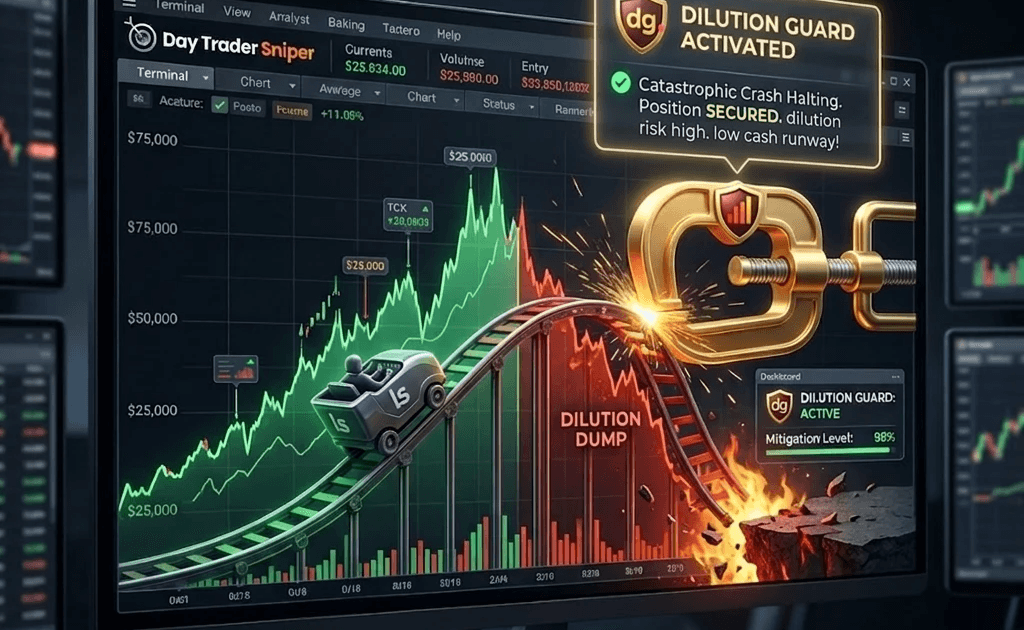
The headline looked good. The float was small. The stock was up 40% pre-market.
You bought. It reversed. Hard.
You weren't wrong about the catalyst. You were wrong about what was happening behind it.
That's a dilution trap. And in small-cap momentum trading, it's more common than legitimate breakouts.
What Is a Dilution Trap?
A dilution trap is a situation where a positive-looking catalyst drives a stock higher, but insiders, management, or institutional holders use that buying pressure to sell millions of shares into the move - collapsing the price after retail traders have entered.
The catalyst is real. The move up is real. But the move up was engineered to create exit liquidity for someone else.
You were the exit.
The mechanism is dilution - new shares entering the float through shelf offerings, ATM agreements, PIPE deals, or warrant conversions. These shares don't show up in the headline. They show up in SEC filings that most traders never read.
Why Dilution Traps Are So Common in Small-Cap Trading
Small-cap companies are, almost by definition, capital-constrained. They need cash to operate. The cheapest and fastest way to raise cash is to sell new shares - but doing that on a quiet day destroys the stock price.
The playbook for a dilution event looks like this:
Company files an S-3 shelf registration (permission to sell shares later)
Company engineers a positive catalyst - partnership announcement, clinical trial update, reverse merger
Stock gaps up on the news
Retail traders buy the move
Company (or PIPE investors, or ATM counterparty) sells millions of shares into the buying pressure
Stock reverses, volume fades, retail is trapped
This isn't illegal. It's not even unusual. It's how dozens of small-cap companies fund their operations every quarter.
The only way to protect yourself is to know the filing history before the catalyst pops.
The Four Dilution Signals to Check Before Every Trade
1. S-3 Shelf Registration
An S-3 is a filing that gives a company permission to sell additional shares at any time, up to the amount registered. It doesn't mean they're selling today - it means the gun is loaded.
Search the company's SEC Edgar filings for a recent S-3. If one exists and the amount is significant relative to the current float, treat any catalyst move with suspicion.
2. ATM Agreement (At-The-Market Offering)
An ATM agreement allows a company to sell shares continuously into the open market at current prices - no fixed offering price, no announcement. It's the quietest form of dilution.
ATM agreements are disclosed in 8-K filings and prospectus supplements. If an ATM is active, shares can be sold into any volume spike - including the one you're trying to buy.
3. PIPE Deal (Private Investment in Public Equity)
A PIPE deal brings in institutional investors at a discount to market price, often with warrants attached. Those investors frequently have registration rights - meaning they can sell into the open market shortly after the deal closes.
A recent PIPE deal + a positive catalyst = institutional investors cashing out into retail buying. Check 8-K filings for PIPE announcements.
4. Cash Position and Going Concern
A company with $300K in cash and a going concern notice from its auditors is not in a position to grow. It's in survival mode. Any positive catalyst from a company in this position is almost certainly being used to raise capital.
Check the most recent 10-Q or 10-K for cash on hand and going concern language. These numbers tell the real story behind the headline.
How to Read the Dilution Stack Before You Trade
When a catalyst hits, the full picture looks like this:
Signal | What to check | Where to find it |
Shelf offering | S-3 filing, amount registered | SEC Edgar |
ATM agreement | 8-K, prospectus supplement | SEC Edgar |
PIPE deal | 8-K, recent 6 months | SEC Edgar |
Cash position | 10-Q, balance sheet | SEC Edgar |
Going concern | 10-Q/10-K, auditor notes | SEC Edgar |
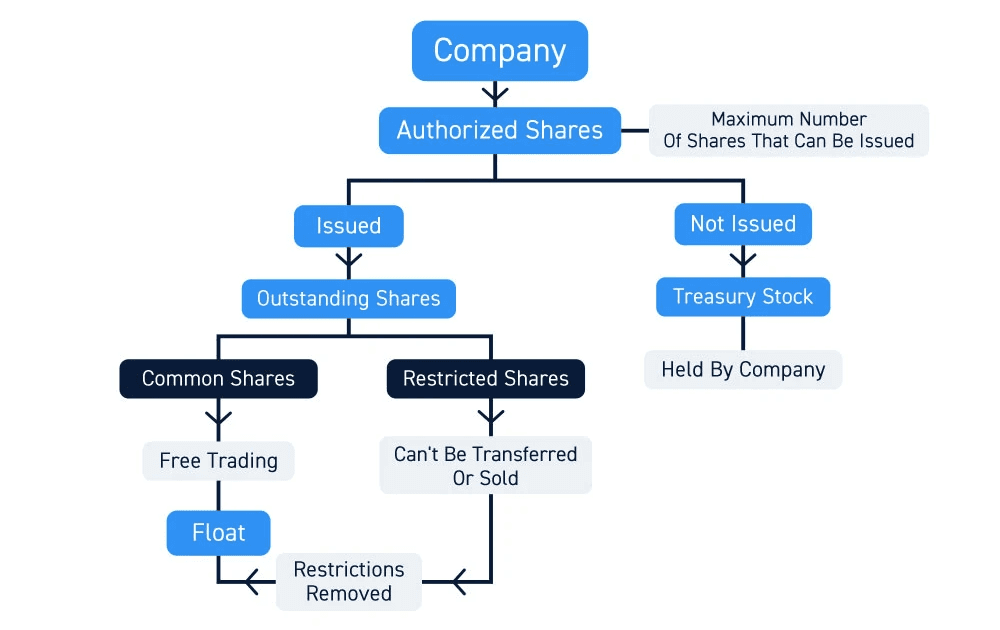
Float size | Outstanding minus restricted shares | Trading View / Broker Data |
Running this check manually takes 5–10 minutes. Most small-cap catalyst moves are already well underway by then.
That's the latency problem. The traders who avoid dilution traps consistently aren't doing this research faster than you during the move. They're doing it before the move - pre-market, the night before, or in real time with tools that surface the filing data the moment a catalyst hits.
What a Dilution Trap Looks Like on the Chart
Dilution traps have a recognizable pattern once you know what you're looking for:
Pre-market: Clean gap on positive catalyst, strong volume
Open: Fast initial push, stock breaks pre-market high briefly
5–10 minutes in: Volume drops sharply, price stalls at resistance
10–20 minutes in: First red candle on elevated volume - this is the distribution
Rest of session: Steady grind lower, closing near the day's low
The chart looked like a gap and go. It was actually a distribution event.
The giveaway in real time: volume drops while price is still near highs. That's not consolidation. That's buyers disappearing while sellers hold the ask.
FAQ
What is a dilution trap in stock trading? A dilution trap occurs when a positive catalyst drives a stock higher while insiders or institutional investors use the volume to sell large quantities of shares - collapsing the price after retail traders enter.
What is an ATM offering in stocks? An ATM (At-The-Market) offering is an agreement that allows a company to sell new shares directly into the open market at current prices, continuously and without announcement. It's one of the most difficult forms of dilution to detect in real time.
How do I find S-3 filings for a stock? Go to SEC Edgar (sec.gov/cgi-bin/browse-edgar), search the company's ticker, and filter by filing type "S-3." Any recent shelf registration will appear there.
What is a going concern notice? A going concern notice is a disclosure by a company's auditors that there is substantial doubt about the company's ability to continue operating. It's a severe red flag when combined with a catalyst-driven price spike.
How do I know if a small-cap catalyst is real? Verify the catalyst in a primary source (SEC filing, verifiable press release). Cross-reference against the dilution history. If the company has active dilution mechanisms and limited cash, treat the catalyst as a distribution event until proven otherwise.
The Bottom Line
Dilution traps don't announce themselves. They look exactly like legitimate setups - right up until the moment the stock reverses and you're holding the bag.
The defense is not better chart reading. It's knowing the filing history before the catalyst pop. Float, cash position, shelf registration, ATM status - these are the numbers that tell you whether the move is a genuine breakout or a managed exit.
If you want Dilution Guard status attached to every catalyst alert - clean, armed, or active - before the first candle prints, Day Trader Sniper is building Dilution Guard now. Today, the Stock Card already surfaces float and float rotation in real time, so you're not flying blind on distribution risk.




©2026 Day Trader Sniper - all rights reserved