
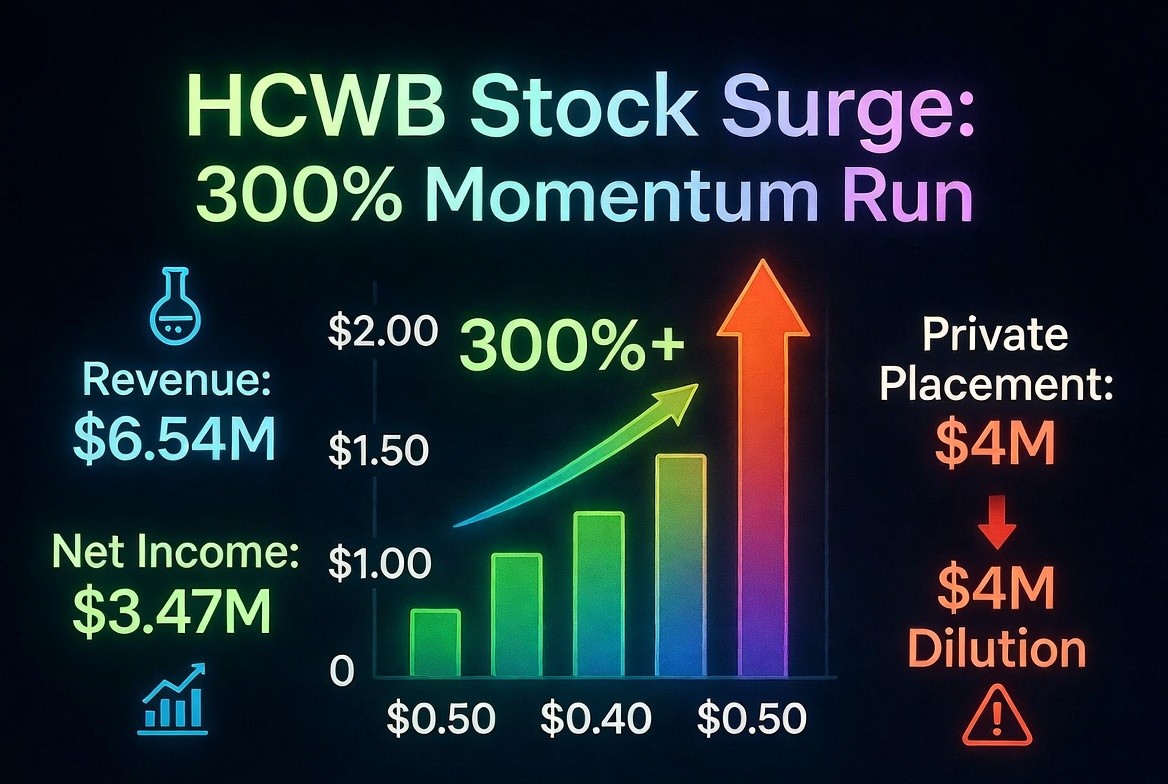
HCWB moved from under $0.50 to above $2.00 in a matter of days. The setup looked clean: surprise profitability, pipeline progress, institutional attention. For momentum traders scanning biotech catalyst stocks, this had every signal of a legitimate runner.
Buried in the same news cycle was a $4 million at-the-market private placement.
That one line changes everything.
What Drove the HCWB Surge
HCW Biologics (NASDAQ: HCWB) reported Q1 2026 earnings that no one expected. The company posted $3.47 million in net income on $6.54 million in revenue. A company trading below $0.50 - suddenly showing profitability.
For small-cap biotech, unexpected profitability is a rare event. It triggers a re-rating. Short sellers start covering. Momentum traders start entering. Volume spikes. A thin float gets consumed fast.
Alongside the earnings beat, HCW published IND-enabling data for HCW11-040 - a therapeutic candidate targeting bronchopulmonary dysplasia (BPD). Pipeline advancement stacked on top of a financial catalyst. Two reasons to move. One float.
The result: shares pushed past $2.00. On a 4-hour chart, the move registered over 300% from base. Relative volume confirmed the move was real. Price action said one thing: momentum.
The Signal Most Traders Ignored
On the same day the earnings news hit, HCWB priced an underwritten at-the-market private placement of approximately $4 million.
Read that again.
At-the-market means shares are sold directly into the open market as the price runs. The company is issuing new shares and selling them - into your buying pressure, into your momentum, into the exact move you're trying to ride.
This is not a shelf offering announced months ago. This is active dilution, priced at the peak of a momentum run.
For traders who only read the headline - "Surprise Q1 Profit, Pipeline Update" - this looked like a clean long. For traders who read the full filing, the picture changed immediately.
The $4 million placement wasn't funding a commercial launch. It was funding trials and reducing debt. That's a company burning cash, using its own price surge as the exit window.
How to Read a Biotech Catalyst Setup Like HCWB
When a small-cap biotech runs on earnings and pipeline news simultaneously, the pattern trades differently than a single-catalyst move. Here's how to break it down before you enter:
1. Identify the catalyst type
Earnings surprise is a hard catalyst. Definitive data, not speculation. Stronger than most biotech news and more likely to produce follow-through - unless dilution is active.
2. Check pipeline stage
IND-enabling data means the company plans to file for clinical trials. It has not started them. This adds narrative momentum, not clinical proof. It amplifies the move; it doesn't justify it fundamentally.
3. Pull the SEC filing immediately
Every significant catalyst in a small-cap biotech comes with a filing. Before entry, you need to know what else is in that document. In HCWB's case: the private placement was right there.
4. Cross-reference cash position vs. dilution structure
A company posting $3.47 million net income that still needs to raise $4 million through share issuance is telling you something. One-quarter profitability. Structural dilution. Those two facts describe the same company.
5. Read the placement terms
At-the-market placements are the most dangerous structure for momentum traders. No fixed price. Shares sold as the stock runs. Sellers have every incentive to let momentum extend before supply hits.
The Conviction-Collapse Pattern
This is a textbook example of the conviction-collapse pattern in small cap momentum stocks.
The setup builds conviction: earnings beat, pipeline catalyst, volume explosion. Every signal confirms the same thesis. Traders enter with increasing size and confidence.
Then the collapse point hits - not from a failed trial or a bad print, but from the filing that was there the whole time. The placement was announced in the same news cycle. Always visible. Most traders never looked.
The move from $2.00 back toward base doesn't happen because the fundamentals changed. It happens because the shares exist. New shares sold into a momentum run always find the market.
What Separates the Traders Who Caught This
The trader who flagged the dilution signal didn't do extra work. They had the right information in front of them at the right moment.
HCWB's private placement was an SEC filing. The moment it hit Edgar, it was parseable. A trader with real-time SEC filing alerts saw the dilution flag land alongside the earnings catalyst - not after the damage was done.
That's the difference between riding a 300% runner and walking into a trap. The underlying data was identical. The timing wasn't.
FAQ
Was HCWB's Q1 profit a reliable signal for a sustained move?
One quarter of profitability in a clinical-stage biotech is a catalyst, not a business confirmation. It moves price. Whether it holds depends on cash position, dilution activity, and whether the next quarter repeats. In HCWB's case, the active ATM placement answers the cash question directly.
What is an at-the-market private placement?
An ATM placement allows a company to sell newly issued shares directly into the open market over time, at prevailing prices. Unlike a fixed-price offering, ATM structures give the company maximum flexibility to sell into momentum runs - making them the most trader-unfriendly dilution structure in small-cap markets.
How do you spot dilution risk before entering a biotech momentum trade?
Pull the most recent SEC filings before entry: S-3, S-1, 424B filings, ATM prospectus supplements. Look for active shelf registration, ATM programs, or preferred stock conversion rights. Any of these structures means new shares can hit the market while you're holding.
What's the difference between a hard catalyst and soft catalyst in biotech?
A hard catalyst is a binary event with definitive data: earnings, FDA approval, Phase 3 readout. A soft catalyst is speculative or narrative-driven: early pipeline updates, partnership announcements, management commentary. HCWB's Q1 earnings were a hard catalyst. The IND-enabling data was a soft catalyst stacked on top - useful for narrative, not for de-risking the trade.
What does a private placement mean for a stock's momentum?
A private placement - especially an ATM structure - introduces new supply into the market. When it's priced during an active momentum run, it means the company is selling shares into your buying pressure. Supply increasing while demand peaks is how momentum runs end.
The Edge You Need Before the Next Biotech Runner
HCWB gave traders everything they needed to see the full picture. The earnings beat was real. The dilution risk was real. Both were in the same news cycle, minutes apart.
The traders who lost money on this move weren't wrong about the catalyst. They were missing one data point at the moment it mattered.
If you want the complete picture on biotech catalyst stocks before the first candle prints - earnings, pipeline, and SEC filing status in one place - Day Trader Sniper fires real-time catalyst alerts the moment a filing or news event hits.




©2026 Day Trader Sniper - all rights reserved