
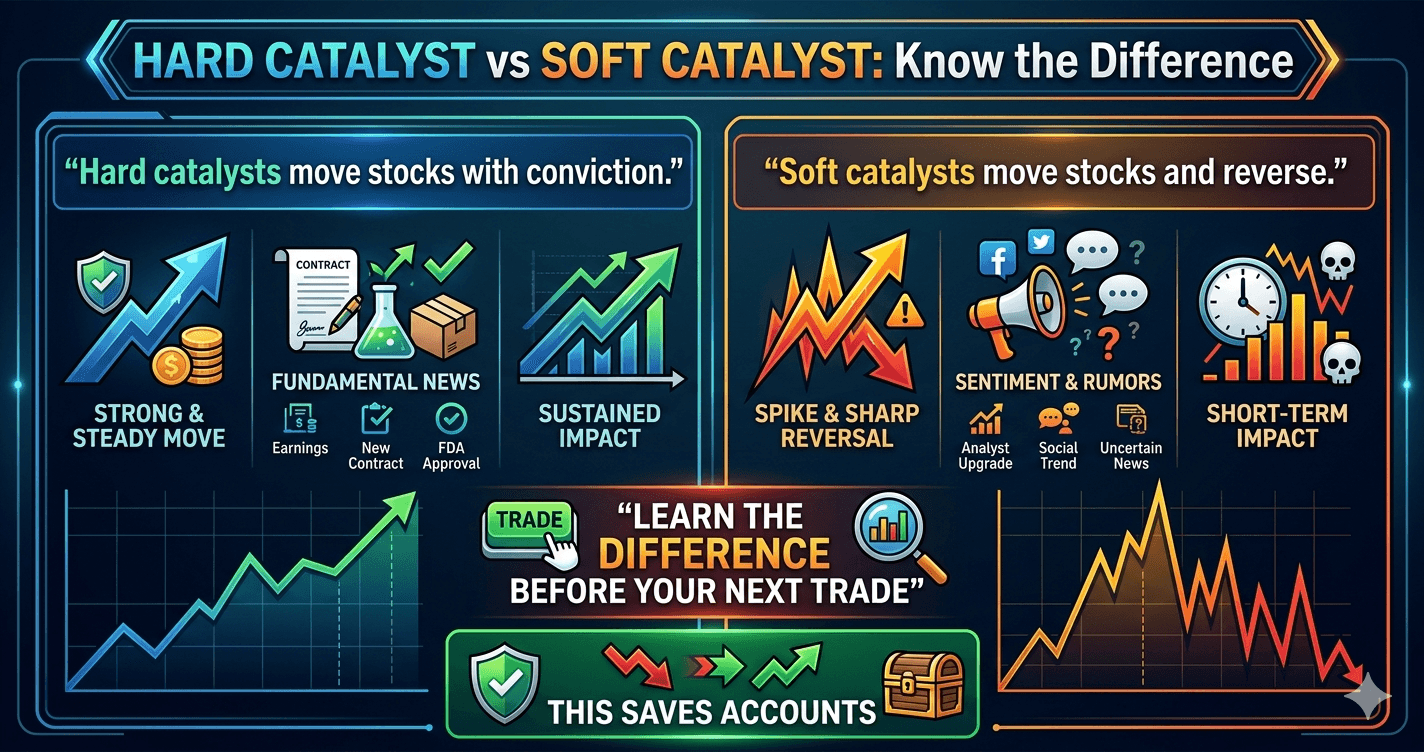
Two stocks gap up 30% pre-market. Same float. Same volume. Different catalysts.
One continues higher through the session. The other reverses within 10 minutes of the open and closes near the low of the day.
The difference was not the chart. It was not the float. It was not the volume.
It was the catalyst.
Specifically: one was hard. One was soft. Understanding this distinction before you enter a trade is one of the highest-value skills in momentum day trading.
What Is a Hard Catalyst?
A hard catalyst is a verifiable, binary event that forces an immediate and definitive repricing of a stock.
"Verifiable" means you can confirm it in a primary source - an SEC filing, an FDA announcement, a signed contract in an 8-K. Not a press release about a press release. The underlying document exists and is publicly accessible.
"Binary" means it either happened or it didn't. FDA approved or FDA rejected. Merger completed or merger terminated. Earnings beat or missed. There's no ambiguity about what occurred.
"Immediate repricing" means the market doesn't debate the news - it reacts. Price moves fast because the information is clear enough that buyers and sellers can reprice immediately.
Examples of hard catalysts:
FDA drug approval or clearance
Positive Phase 3 clinical trial results (primary endpoint met)
Earnings beat on revenue and EPS
Completed reverse merger or acquisition (8-K, Item 1.01)
Nasdaq compliance restoration
Major contract signing with disclosed terms
Hard catalysts produce gap and go setups when the float is small and dilution is clean. The move has conviction behind it because the information is unambiguous.
What Is a Soft Catalyst?
A soft catalyst is vague, speculative, or unverifiable news that moves a stock based on perception rather than confirmed fact.
Soft catalysts are written to sound significant. They trigger price movement because retail traders can't distinguish them from hard catalysts fast enough. By the time the market figures out the news was noise, early buyers have exited and late buyers are trapped.
Examples of soft catalysts:
"Company enters into a letter of intent to explore strategic partnership opportunities"
"Management believes positive milestones are achievable in the near term"
"Company announces collaboration agreement" (with no disclosed terms, no revenue)
"Phase 2 results show promising trends" (without primary endpoint data)
"Analyst upgrades stock to Outperform" (on a company with no revenue)
The language is optimistic. The substance is thin. And in small-cap trading, thin substance combined with low float and high volume is the recipe for the most violent reversals in the market.
Why Soft Catalysts Move Stocks at All
If soft catalysts are just noise, why do they produce 30–50% pre-market gaps?
Two reasons:
Retail speed disadvantage: Most retail traders do not read the underlying SEC filing or press release with critical analysis. They see the headline summary on a news feed, assume it's significant, and buy. The move starts before the reality is priced in.
Institutional distribution: Soft catalysts are frequently used deliberately by insiders or institutional holders to create volume for exit purposes. The company issues a vague but positive-sounding announcement. Retail traders pile in. The holders who already knew the news was thin use the buying pressure to distribute their shares.
The soft catalyst was not the breakout. It was the exit ramp - and you were the buyer at the top.
How to Distinguish Hard from Soft in Real Time
When a catalyst hits, ask these three questions before touching the stock:
1. Can I verify it in a primary source? If the news exists only as a press release summary and there's no corresponding SEC filing or verifiable document, it's soft until proven otherwise.
2. Is the outcome binary and confirmed? Did something definitively happen, or is the company describing something that might happen? "Phase 3 trial meets primary endpoint" is binary and confirmed. "Phase 2 shows encouraging signals" is not.
3. Are there disclosed financial terms? A "major partnership" with no disclosed contract value, no named partner, and no terms in the filing is almost always soft. Legitimate material contracts are filed with terms in 8-K Item 1.01.
If you cannot answer yes to all three questions, the catalyst is soft. Adjust your position size, your entry timing, or your decision to trade accordingly.
Hard vs Soft: What It Looks Like on the Chart
Hard catalyst behavior:
Gap holds pre-market, builds toward the open
First candle is high volume, closes near high
Continuation for 15–60+ minutes
Pullbacks are shallow and bought
Volume sustains through the morning
Soft catalyst behavior:
Gap opens strong but often fades within the first 5–15 minutes
First red candle on elevated volume signals distribution
Volume drops sharply after the initial spike
Repeated attempts to reclaim the open price fail
Closes in the lower half of the day's range
The chart difference is clearest in hindsight. The filing difference is visible before you enter - if you look.
FAQ
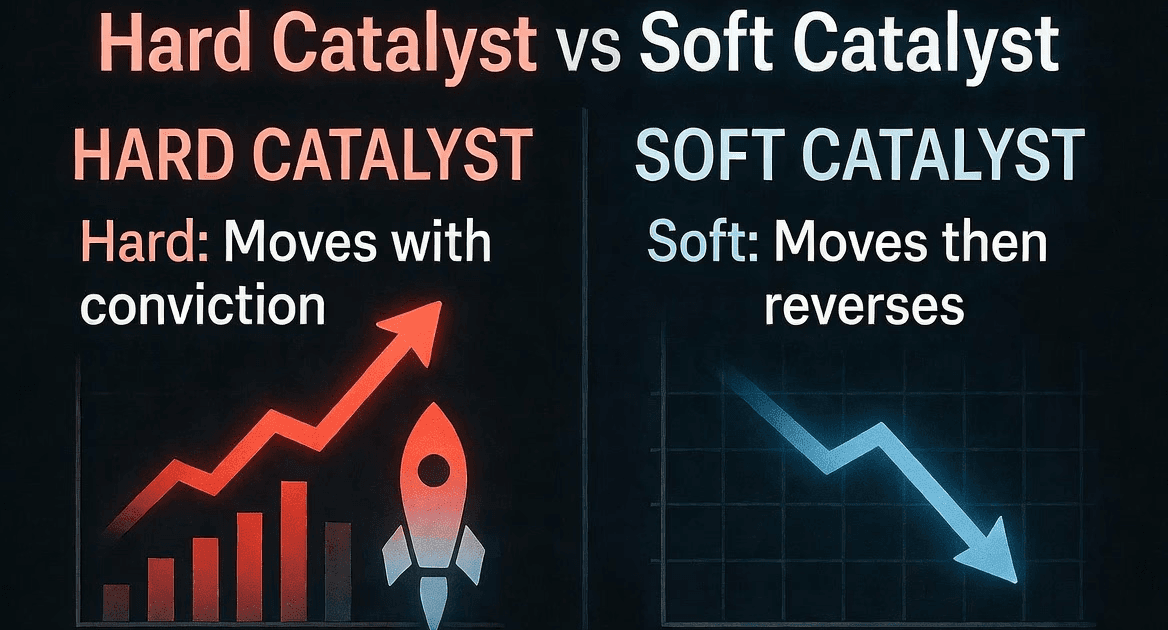
What is the difference between a hard and soft catalyst in stocks? A hard catalyst is a verifiable, binary event that forces immediate repricing - FDA approval, earnings beat, completed merger. A soft catalyst is vague or speculative news that moves stocks on perception, not confirmed fact.
Do soft catalysts ever produce good trades? Occasionally, but the risk profile is fundamentally different. Soft catalyst moves are more likely to reverse quickly and are more susceptible to manipulation. Position sizing and entry timing must reflect the higher uncertainty.
How do I tell if a partnership announcement is a hard or soft catalyst? Check for an 8-K filing with disclosed terms, a named partner, and a revenue or contract value. If the announcement is a press release only with no corresponding filing or disclosed financials, it's soft.
What happens when a soft catalyst reverses? Soft catalyst reversals are typically fast and severe on low float stocks. The same float that amplified the move up amplifies the move down. Traders caught in the reversal often face 20–40% losses from the day's high within minutes.
The Bottom Line
Hard versus soft is not an academic distinction. It is the single most important filter a momentum trader runs before entering a catalyst trade.
Get it right and you're trading setups with conviction behind them. Get it wrong and you're buying the exit ramp for someone who understood the news before you did.
Know the filing. Know the catalyst type. Know before you enter.
If you want catalyst classification built into every alert - hard vs soft - before the first candle prints, Day Trader Sniper does the classification work so you don't have to.




©2026 Day Trader Sniper - all rights reserved