
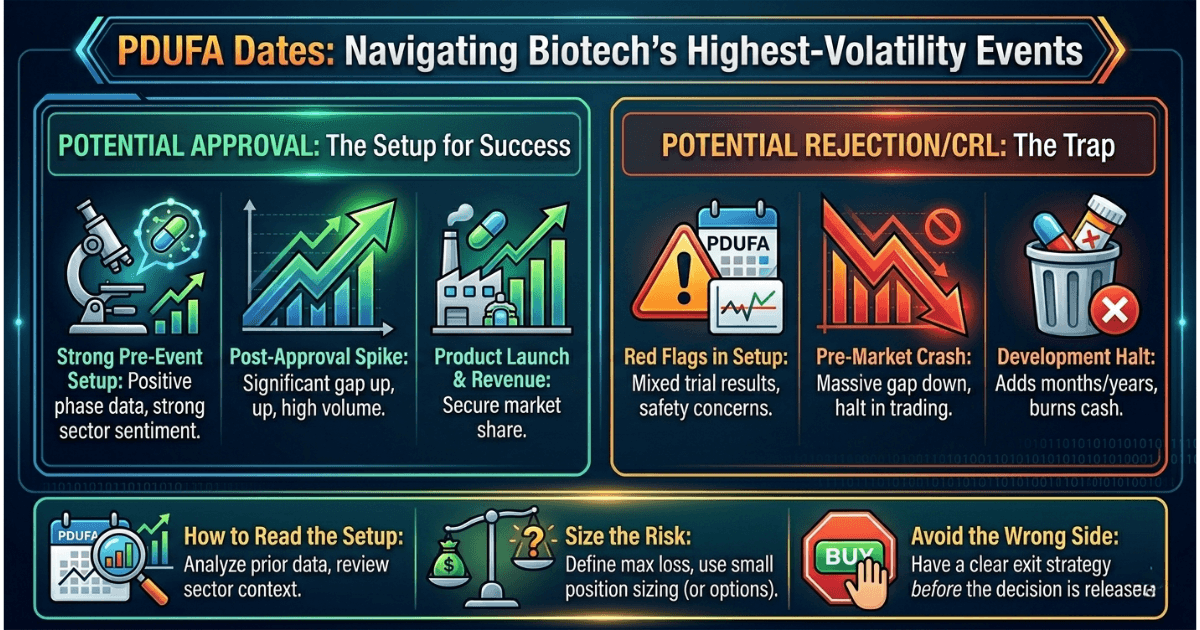
No single event produces more violent single-day moves in the stock market than an FDA decision on a PDUFA date.
Approvals produce 50–300% moves. Rejections produce 60–90% collapses. The same stock. The same float. Completely different outcomes depending on a binary decision from a federal agency.
For momentum day traders, PDUFA dates are both the highest-opportunity and highest-risk events in the calendar. The traders who navigate them consistently are not lucky. They are prepared.
What Is a PDUFA Date?
PDUFA stands for Prescription Drug User Fee Act. Under this legislation, the FDA commits to reviewing New Drug Applications (NDAs) and Biologics License Applications (BLAs) within a set timeframe - typically 10–12 months from filing.
The PDUFA date is the FDA's target decision date for a drug approval or rejection.
For biotech and pharmaceutical companies with a drug in late-stage review, the PDUFA date is the most important date on the calendar. It's the binary event that determines whether the company's lead asset gets approved for commercial sale - or doesn't.
For traders, it's a known, scheduled catalyst with a defined date and a binary outcome. That's a rare and valuable setup.
Why PDUFA Dates Produce Such Large Moves
Three factors combine to create the volatility:
Binary outcome: The FDA approves or rejects. There is no partial approval, no "mostly good" decision. The stock reprices immediately and completely in one direction.
Low float and high short interest: Biotech stocks awaiting FDA decisions typically have small floats and significant short interest from traders betting against approval. An approval triggers a short squeeze on top of the catalyst move - amplifying the upside dramatically.
Long pre-event run: Stocks often drift higher in the weeks before a PDUFA date as traders position for a positive outcome. By the time the decision hits, the stock may already be up 50–100% from its pre-announcement level. A rejection from that elevated level produces catastrophic downside.
The Two PDUFA Trades
There are two distinct ways to trade a PDUFA date. They require completely different approaches.
Trade 1 - The pre-PDUFA momentum play
In the weeks before a PDUFA date, biotech stocks with anticipated positive outcomes often drift higher on increasing volume. This is not a catalyst trade - it's a momentum trade on the anticipation.
The risk: if the FDA issues a Complete Response Letter (CRL, i.e., rejection) or delays the decision, the pre-event run collapses entirely. The pre-PDUFA trade is a position trade, not a day trade. Size accordingly.
Trade 2 - The post-decision catalyst move
The decision drops - pre-market, after hours, or intraday. The stock gaps 50–200% on approval or collapses 60–90% on rejection. This is the catalyst trade.
The challenge: by the time most traders see the news, the initial gap has already occurred. The question is not "should I buy the approval?" - the question is "is there continuation after the gap, or is this the top?"
Post-decision continuation depends on:
Whether the approval was expected (already priced in) or a surprise
Float and short interest (squeeze potential)
Whether any dilution events accompanied the approval (companies often raise capital on FDA approvals)
Volume behavior in the first 5–10 minutes after the open
Reading the Setup Before the Decision
Before a PDUFA date, experienced biotech traders are checking:
The drug's clinical history: Did Phase 2 and Phase 3 trials show strong efficacy? Was the primary endpoint met cleanly? A drug with a clean clinical history has a higher approval probability - though the FDA's decision is never certain.
FDA precedent: Has the FDA approved similar drugs in this class? Are there any Complete Response Letters in the drug's history? Prior FDA feedback on the application matters.
The company's dilution history: Does the company have an active ATM agreement, shelf registration, or PIPE deal? An approval is often used to immediately raise capital. A clean approval followed by a surprise dilution filing is a common trap.
Short interest: High short interest going into a PDUFA date means a short squeeze is possible on approval. This is a significant amplifier for the upside move.
Cash position: Is the company financially stable enough to commercialize the drug if approved? A company with $2M in cash getting an approval will immediately raise capital. That dilution can suppress the post-approval move.
The Risks Specific to PDUFA Trading
The binary wipeout: If you're holding a long position into a PDUFA date and the FDA issues a rejection, 60–90% losses are common in a single session. Position sizing into binary events must reflect the possibility of a worst-case outcome.
The buy-the-rumor-sell-the-news trap: A stock that has already run 100%+ into its PDUFA date may not continue higher on approval. The move was already priced. Traders who chased the pre-event run and hold through the decision often sell on the news - creating a top right at the approval announcement.
The CRL trap: A Complete Response Letter is not a rejection - it's a request for additional information before approval. The market often treats it like a rejection initially, causing a violent sell-off. Some CRLs are minor and resolvable; others signal a fundamental problem. Reading the CRL language carefully determines whether the sell-off is an overreaction or justified.
FAQ
What is a PDUFA date in stock trading? A PDUFA date is the FDA's target date for making an approval or rejection decision on a New Drug Application. It represents a binary catalyst event that can cause 50–300% moves on approval or 60–90% collapses on rejection.
How do I find upcoming PDUFA dates? The FDA publishes PDUFA dates in press releases and meeting calendars. Biotech-focused financial sites compile PDUFA calendars updated regularly.
What is a Complete Response Letter (CRL) from the FDA? A CRL means the FDA is not approving the drug in its current form and is requesting additional information or studies. It's not a permanent rejection, but it typically causes a significant stock sell-off.
What happens to a biotech stock after FDA approval? On approval, biotech stocks typically gap up sharply - 50–200%+ on low float names. Whether the move continues depends on whether the approval was expected, the short interest, and whether the company immediately raises capital on the news.
Is it safe to hold biotech stocks through a PDUFA date? Holding through a binary event like a PDUFA date carries extreme risk. A rejection can erase 60–90% of value in a single session. Position sizing must reflect the binary risk.
The Bottom Line
PDUFA dates are the highest-volatility scheduled events in biotech day trading. The opportunity is real. So is the risk.
The traders who navigate PDUFA setups consistently are not guessing on approval probability. They're reading the clinical history, the dilution status, the short interest, and the pre-event price action - and sizing their risk to reflect the binary nature of the outcome.
If you want real-time biotech catalyst alerts - FDA decisions, PDUFA outcomes, clinical trial filings - with real-time catalyst classification, Day Trader Sniper fires the alert the moment it hits.




©2026 Day Trader Sniper - all rights reserved